Modular Kitchen as a Career: Build Skills, Create Opportunities and Start Your Own Business
The demand for well-designed and functional kitchens is growing as more homeowners, builders and interior designers look for modern solutions for their homes. This growth has also created opportunities for people who want to enter the modular furniture industry. Modular Kitchen as a career can be an interesting option for interior designers, furniture professionals, entrepreneurs and even beginners who want to build a specialised career or business.
A modular kitchen is not simply about installing cabinets. It involves design, measurements, material selection, hardware, production, costing, installation and customer management. Developing knowledge in all these areas can help a person build a practical career in this industry.
Why Choose Modular Kitchen as a Career?
One of the major advantages of choosing Modular Kitchen as a career is the variety of career paths available. A person does not necessarily have to work as an employee. After developing the right skills and practical understanding, there are several possible directions.
You can work as a:
- Modular kitchen designer
- Kitchen sales professional
- Production supervisor
- Modular kitchen installer
- Furniture manufacturing professional
- Interior design professional
- Kitchen project manager
- Modular kitchen business owner
- Kitchen hardware and accessories supplier
Entrepreneurs can also establish their own modular kitchen manufacturing or installation business and work with homeowners, builders, architects and interior designers.
What Skills Are Required?
A successful career in modular kitchens requires more than just knowledge of kitchen design. Understanding the complete process is important.
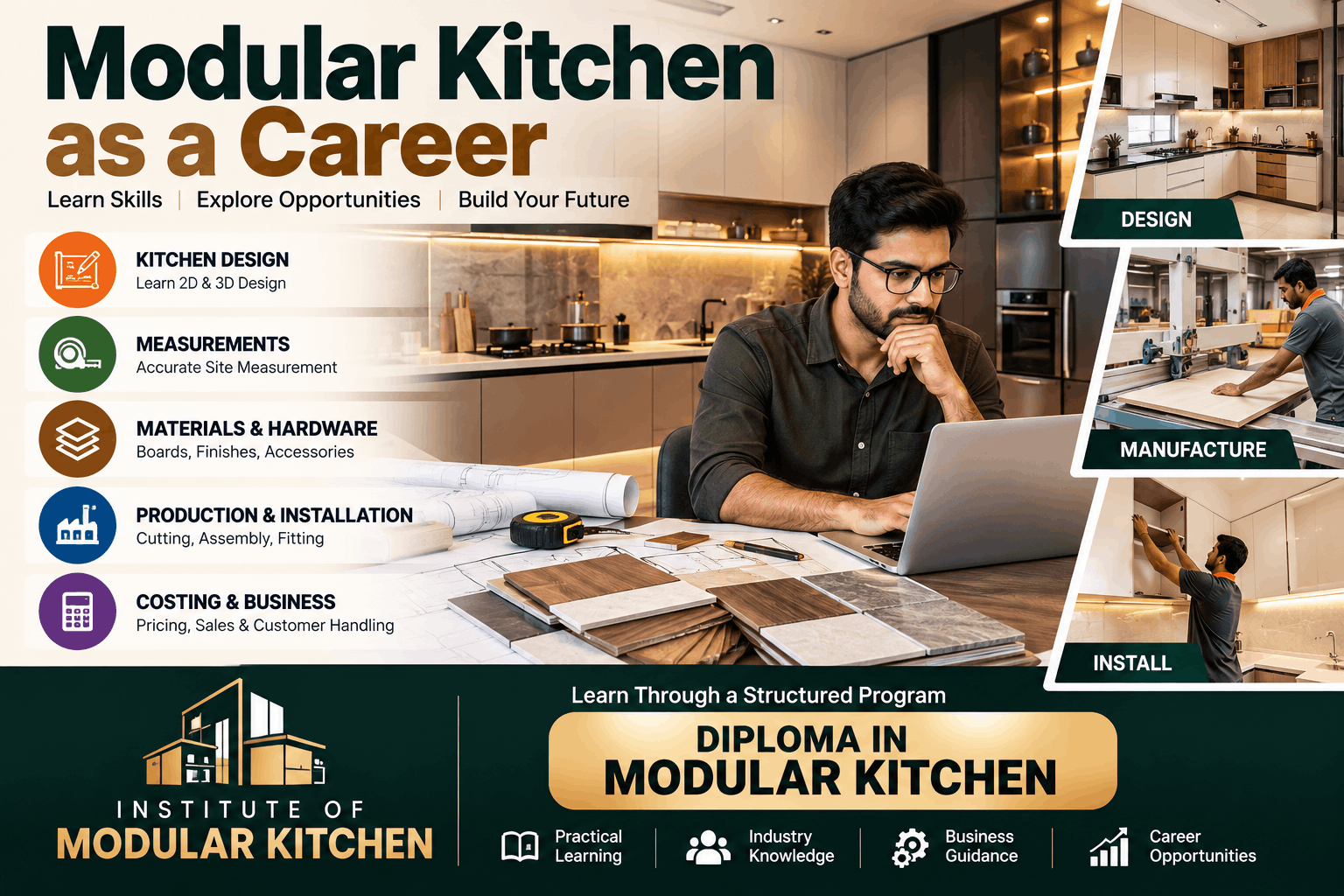
1. Kitchen Design
Learning 2D and 3D kitchen design helps professionals convert a customer’s requirements into a practical kitchen layout. Knowledge of ergonomics, storage planning, work triangles, finishes and aesthetics is useful when preparing designs.
2. Measurements
Accurate site measurement is an essential part of modular kitchen work. Professionals need to understand wall dimensions, windows, doors, plumbing points, electrical points, ceiling height and other site conditions before finalising a design.
3. Materials and Hardware
A professional should understand commonly used boards, laminates, acrylics, finishes, countertops, hinges, drawer systems, baskets and other kitchen accessories. Knowledge of hardware helps in selecting products according to the design, budget and functional requirements.
4. Cutting, Production and Installation
Understanding how modular kitchen components are manufactured is another important skill. Knowledge of cut lists, carcass construction, shutters, edge banding, drilling, assembly and installation can help professionals coordinate projects more effectively.
5. Costing and Business Skills
If your goal is entrepreneurship, costing and customer management are particularly important. You need to understand material quantities, hardware costs, manufacturing expenses, installation costs, transportation, labour and profit margins.
Diploma in Modular Kitchen
For people who want structured training, the Diploma in Modular Kitchen can provide a focused way to learn the different aspects of the industry.
The Institute of Modular Kitchen conducts a Diploma in Modular Kitchen designed around the practical requirements of the modular kitchen industry. The course can be considered by people who want to develop knowledge of kitchen design, measurements, materials, costing, customer handling, production and business setup.
Instead of learning individual topics separately, structured training can help learners understand how the different stages of a modular kitchen project connect with each other.
Who Can Consider This Career?
Modular Kitchen as a career can be considered by people from different backgrounds. Interior designers can add specialised kitchen knowledge to their existing skills. Furniture professionals can expand into modular kitchen manufacturing, while entrepreneurs can learn the fundamentals required to start a specialised business.
Even people without extensive industry experience can explore this field if they are willing to learn design, materials, production and customer-management skills.
Career or Business?
An important point to understand is that modular kitchens can offer both employment and entrepreneurship opportunities.
Someone interested in employment can develop skills in design, sales, production or project management. Someone with an entrepreneurial mindset can explore starting a modular kitchen dealership, design studio, manufacturing unit or installation service.
The right path depends on an individual’s skills, investment capacity, experience and long-term objectives.
Learn Before You Start
Starting a modular kitchen business without understanding the basics can create problems with measurements, costing, material selection, production and installation. Practical education can therefore be useful before investing heavily in machinery, inventory or a manufacturing facility.
The Institute of Modular Kitchen offers the Diploma in Modular Kitchen for learners who want to understand the industry in a structured manner. Those interested can explore the course and decide whether this field matches their career or business goals.
Conclusion
Modular Kitchen as a career offers multiple possibilities across design, manufacturing, sales, installation, project management and entrepreneurship. As customers increasingly look for organised and customised kitchen solutions, professionals with practical industry knowledge can explore different opportunities in this field.
For anyone seriously considering this profession, learning the fundamentals of design, measurement, materials, hardware, production, costing and customer management is a useful starting point. A structured Diploma in Modular Kitchen from the Institute of Modular Kitchen can be one option for people who want focused education before entering or expanding in this industry.