Kitchen Designing Course: Build a Career in Modular Kitchen Design
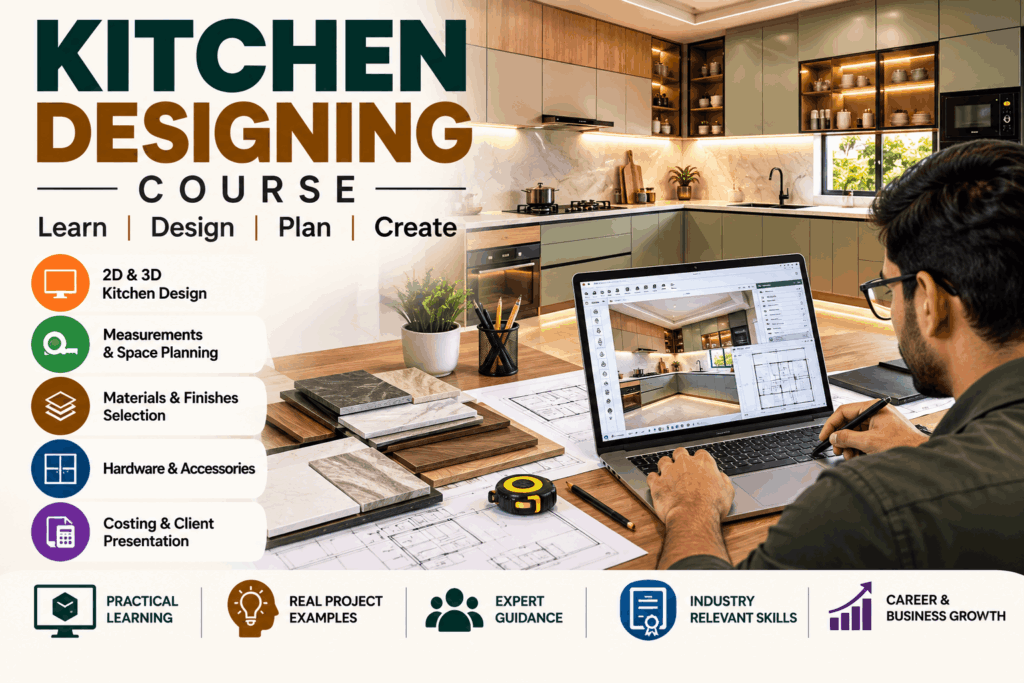
The demand for professionally designed kitchens is growing rapidly as homeowners increasingly look for functional, stylish, and space-efficient interiors. This has created exciting career opportunities for people who want to work in kitchen design, interior design, or the modular furniture industry. A Kitchen Designing Course can help students develop the practical knowledge and technical skills required to turn kitchen ideas into professionally designed spaces.
Whether you are an interior designer, architect, furniture professional, business owner, or someone looking to start a new career, learning kitchen design can be a valuable skill in today’s growing interior industry.
What Is a Kitchen Designing Course?
A Kitchen Designing Course is a professional training program that teaches you how to plan, design, and execute modern kitchens. It generally covers everything from understanding kitchen measurements and layouts to creating 2D and 3D designs.
A good course should not focus only on software. Professional kitchen designing also requires an understanding of materials, hardware, functionality, ergonomics, costing, and manufacturing.
Students can learn how to design different kitchen layouts such as L-shaped, U-shaped, parallel, straight, and island kitchens while considering the available space and customer’s requirements.
What Will You Learn?
A comprehensive Kitchen Designing Course should provide practical knowledge that can be applied to real projects. Important areas of learning include:
- Kitchen measurements and site assessment
- Kitchen layout planning
- 2D and 3D kitchen designing
- Cabinet and carcass planning
- Shutter and internal storage design
- Kitchen hardware and accessories
- Selection of plywood, HDHMR, MDF and other materials
- Cut-list preparation
- Material calculation and costing
- Understanding kitchen ergonomics
- Customer requirements and design discussions
- Kitchen manufacturing basics
- Installation and project execution
Learning these skills can help students move beyond simply creating attractive designs and understand how a kitchen is actually manufactured and installed.
Why Learn Modular Kitchen Design?
The modular kitchen industry combines creativity, technical knowledge, and business opportunities. A trained kitchen designer can work with homeowners, interior designers, contractors, architects, and modular kitchen manufacturers.
For people who want structured professional training, a Diploma in Modular Kitchen can provide broader knowledge covering kitchen design as well as materials, costing, manufacturing, customer handling, and business setup.
This type of practical education can be especially useful for someone who wants to start a modular kitchen business instead of working only as a designer.
Career Opportunities After the Course
Completing a Kitchen Designing Course can open several career paths. Depending on your skills and experience, you can work as a kitchen designer, modular furniture designer, interior design professional, design consultant, or sales and design executive.
You can also work with modular kitchen manufacturers or interior companies. Another option is to start your own kitchen design and manufacturing business and offer complete solutions to customers.
The combination of design knowledge and business understanding can be particularly useful for entrepreneurs who want to build a long-term career in the modular kitchen industry.
Who Should Join a Kitchen Designing Course?
This course can be suitable for:
- Students interested in interior design
- Interior designers who want to specialize in kitchens
- Architects and design professionals
- Furniture and carpentry professionals
- Business owners
- Homemakers looking for a new professional skill
- Entrepreneurs planning to start a modular kitchen business
- Professionals looking to expand their existing interior services
You do not necessarily need extensive prior experience to begin learning kitchen design. A practical course can help you understand the process step by step.
Choose Practical Training Over Theory
Kitchen design is a practical profession. Therefore, while choosing a Kitchen Designing Course, look for training that includes real-world projects, measurements, material calculations, costing, hardware knowledge, and manufacturing processes.
The objective should be to understand the complete journey—from taking measurements at the site and creating the design to preparing the cut list, calculating costs, manufacturing the components, and completing installation.
Start Your Journey in Kitchen Design
A career in modular kitchen design can combine creativity with technical and business skills. With the right training and hands-on practice, you can develop the confidence to design kitchens professionally and explore opportunities in the growing modular furniture industry.
If your goal is to become a professional kitchen designer or start your own modular kitchen business, a structured Diploma in Modular Kitchen can help you develop knowledge across design, materials, costing, manufacturing, and customer management.
The right Kitchen Designing Course is not just about learning design software—it is about understanding how a kitchen is designed, calculated, manufactured, and delivered as a complete solution.