Institute of Modular Kitchen – Learn the Skills to Build a Successful Career
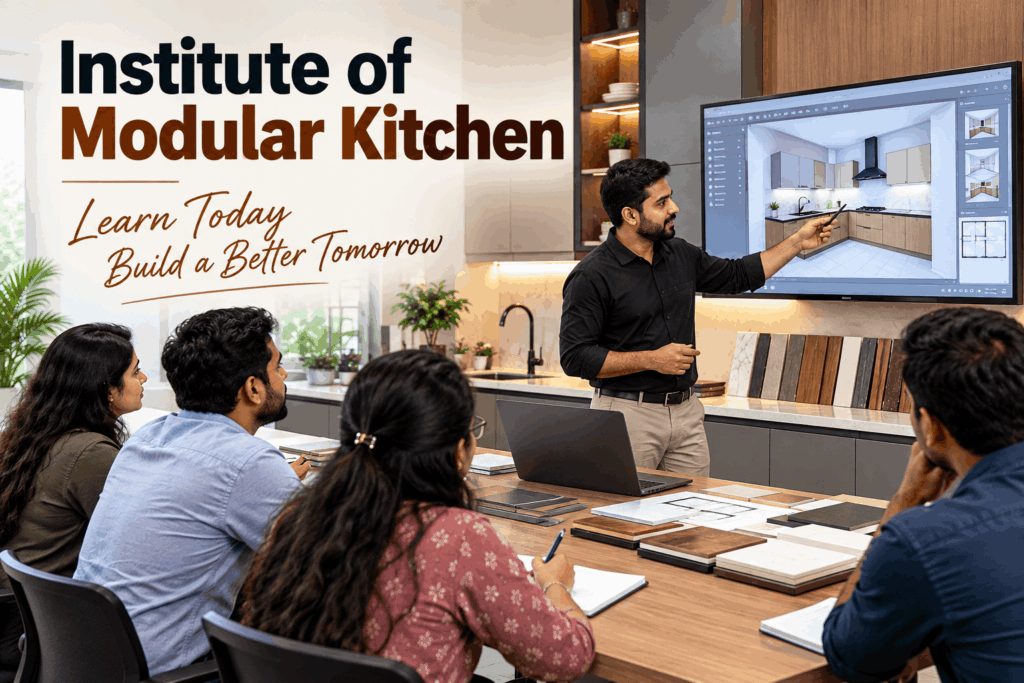
The modular kitchen industry is growing rapidly as homeowners, interior designers, architects, and builders increasingly prefer functional, stylish, and space-efficient kitchen solutions. However, designing and manufacturing a modular kitchen requires more than just knowing how to create an attractive 3D design. Professionals need to understand measurements, materials, hardware, costing, production, installation, and customer management. This is where an Institute of Modular Kitchen can provide practical and industry-focused training.
An Institute of Modular Kitchen is designed to help students and professionals understand the complete modular kitchen process, from the first client discussion to final installation. Whether you are an interior designer, carpenter, furniture professional, businessman, or someone planning to start a modular kitchen business, structured training can help you develop the technical and business skills required in this industry.
Why Choose an Institute of Modular Kitchen?
Learning modular kitchens only through trial and error can take considerable time and may result in costly mistakes. Professional training provides a systematic understanding of the different stages involved in a modular kitchen project.
Students can learn how to take accurate site measurements, understand kitchen layouts, select suitable materials, prepare cut lists, calculate quantities, estimate project costs, and coordinate manufacturing and installation. These skills are useful not only for employment but also for people who want to establish their own modular kitchen business.
A good training institute should focus on practical knowledge rather than only classroom theory. Students should understand how real projects are planned, manufactured, costed, and delivered to customers.
What You Learn in Modular Kitchen Training
A comprehensive Institute of Modular Kitchen program can cover several important areas of the industry.
Kitchen Design
Students learn about different kitchen layouts such as L-shaped, U-shaped, parallel and straight kitchens. Training may also include 2D planning and 3D kitchen visualization to help create functional and attractive designs.
Measurements and Cut Lists
Accurate measurements are essential for successful modular kitchen manufacturing. Students learn how to measure walls, windows, doors, plumbing points and electrical locations and convert these measurements into practical cabinet dimensions and cut lists.
Materials and Hardware
Understanding materials is another important part of modular kitchen training. Students can learn about plywood, HDHMR, pre-laminated boards, laminates, acrylic and other commonly used materials. They can also understand hinges, drawer systems, baskets, channels, handles and other kitchen hardware.
Costing and Estimation
A professional modular kitchen designer should know how to calculate material requirements and project costs. Training in costing helps students prepare quotations, calculate margins and understand the financial aspects of a kitchen project.
Diploma in Modular Kitchen
A Diploma in Modular Kitchen can provide more structured learning for people who want comprehensive knowledge of the industry. Such a program can combine design, measurement, materials, costing, manufacturing, installation, customer handling and business management.
For entrepreneurs, this knowledge can be particularly useful because running a modular kitchen business involves much more than designing kitchens. Understanding production processes, suppliers, labour requirements, pricing and customer communication can help create a more organized business operation.
Who Can Join?
An Institute of Modular Kitchen can be useful for a wide range of learners, including interior designers, architects, carpenters, furniture manufacturers, contractors, students, homemakers and aspiring entrepreneurs.
You do not necessarily need extensive previous experience to begin learning. A structured course can provide the foundation required to understand the industry and gradually develop practical skills.
Build Your Modular Kitchen Career
The modular kitchen industry offers opportunities in design, manufacturing, project management, sales, installation and entrepreneurship. However, practical knowledge and an understanding of the complete workflow are important for long-term growth.
Choosing an Institute of Modular Kitchen that combines technical education with real-world business knowledge can help learners develop skills that are directly applicable to actual projects. From creating the first kitchen layout to preparing the final quotation and managing manufacturing, comprehensive training can provide a clearer understanding of how the industry works.
If your goal is to become a professional modular kitchen designer or start your own modular kitchen business, investing in structured education can be an important first step toward building the right skills and confidence.